Give your team a smarter way to work with product data-from attribution to insights. Harmonya connects product data to consumer reviews so you can act faster and compete smarter.
Synthetic Colors in Cereal: A $2 Billion Reformulation Problem
Target set a deadline to remove synthetic colors from cereal. But the same 383 UPCs sit on shelves at every major US retailer, putting $2 billion in revenue at risk.
Target set a hard deadline to remove synthetic colors from every cereal on its shelves. But the 383 UPCs that deadline affects don't only sit at Target. They're sold at Walmart, Kroger, Costco, and every major US banner, putting over $2 billion in category revenue at risk.
What Target's Mandate Actually Means
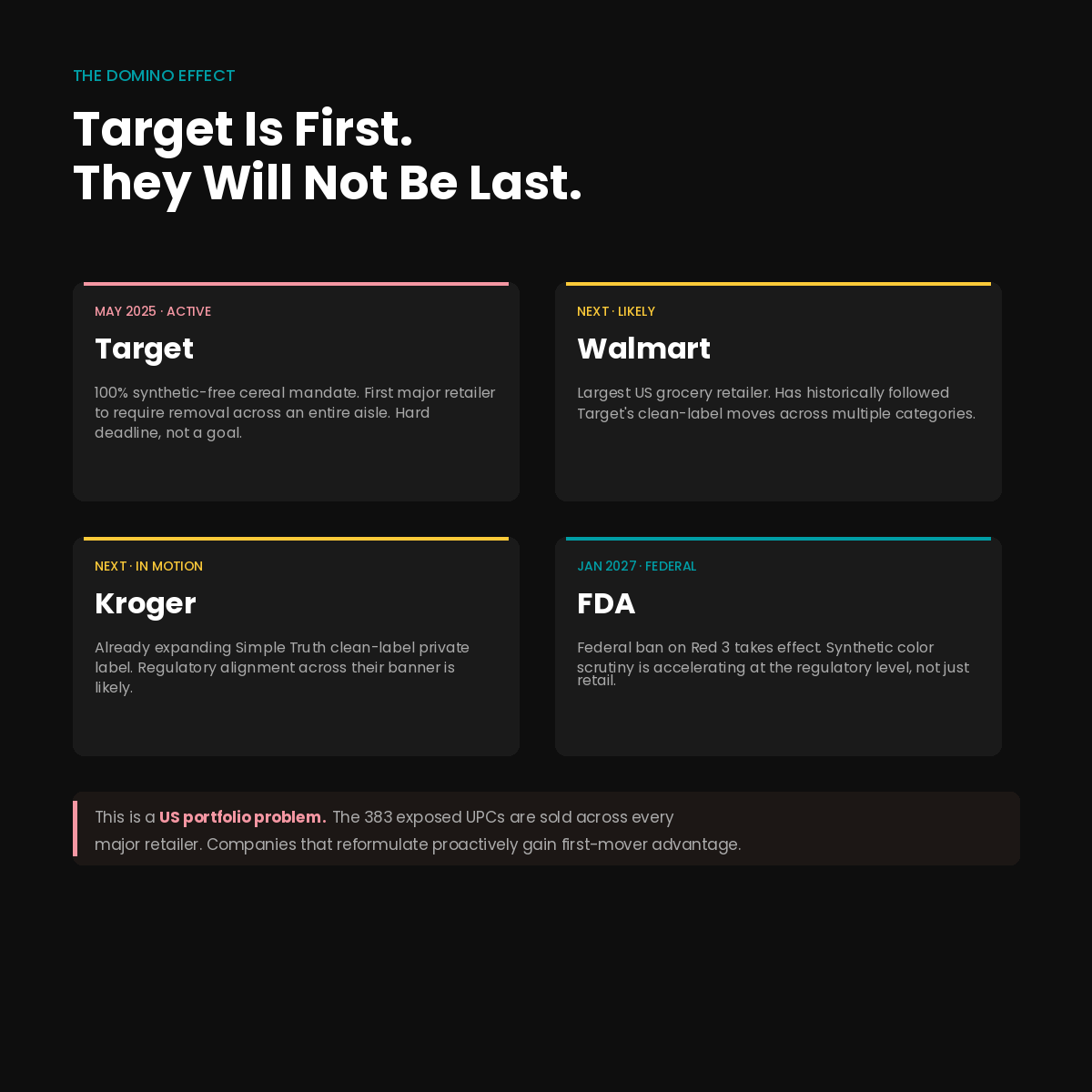
By the end of May 2025, 100% of cereal sold at Target, in stores and online, must be free of certified synthetic colors. Target is the first major US retailer to mandate synthetic color removal across an entire aisle. And this is more than a goal or an aspiration, this is a hard cutoff.
Brands that haven't reformulated by the deadline face delisting from one of the country's largest grocery retailers. But the bigger story isn't just what happens at Target. It's what happens everywhere else.
$2 Billion in Revenue Sitting on Every Shelf
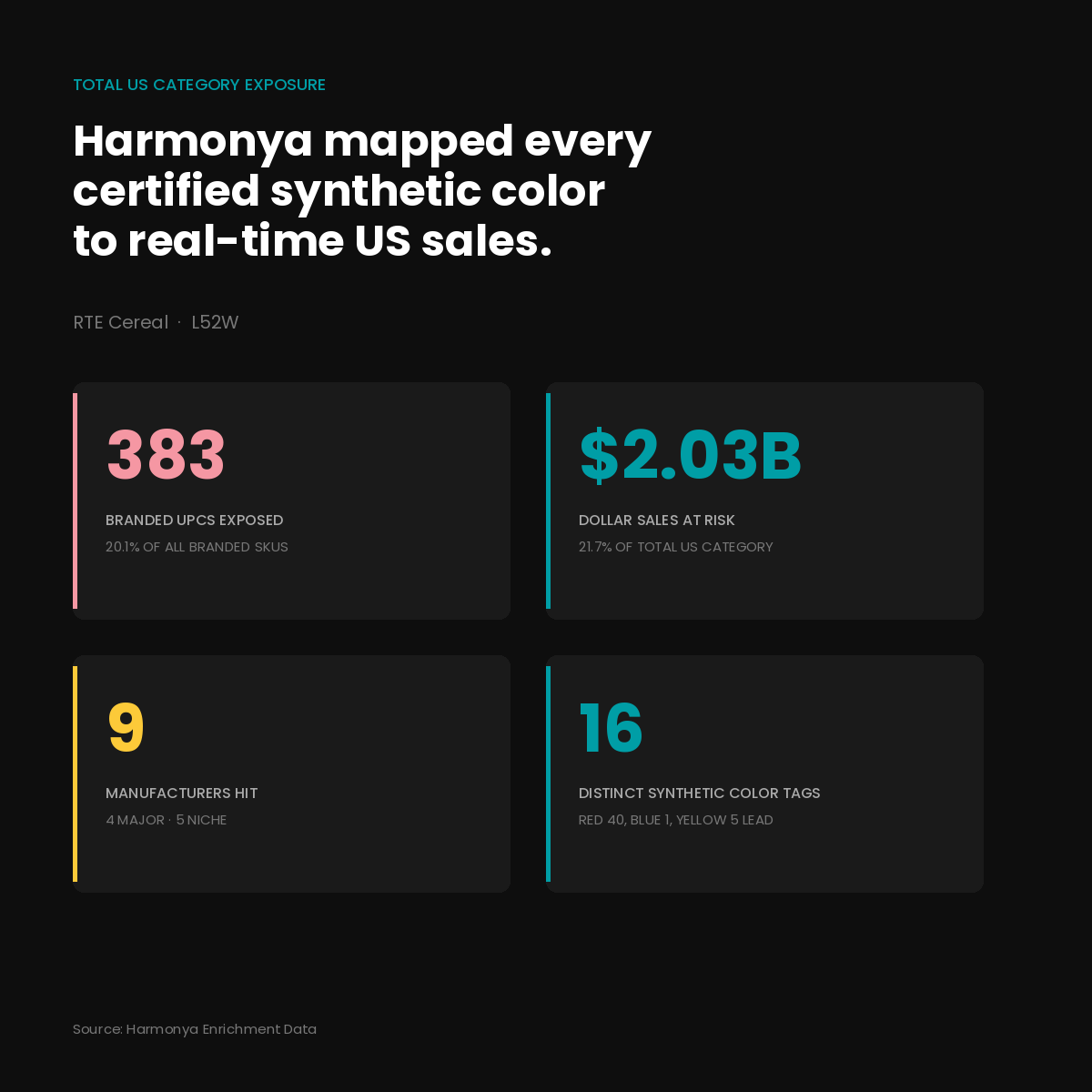
When you map every certified synthetic color in US ready-to-eat cereal against real-time sales data (like we did at Harmonya), the exposure is significant. Across the category, 383 branded UPCs contain at least one synthetic color, representing 20.1% of all branded SKUs and 21.7% of total US category dollar sales.
That's $2.03 billion in at-risk revenue. Nine manufacturers are affected, spanning four major players and five niche brands. And 16 distinct synthetic color ingredients appear across those products.
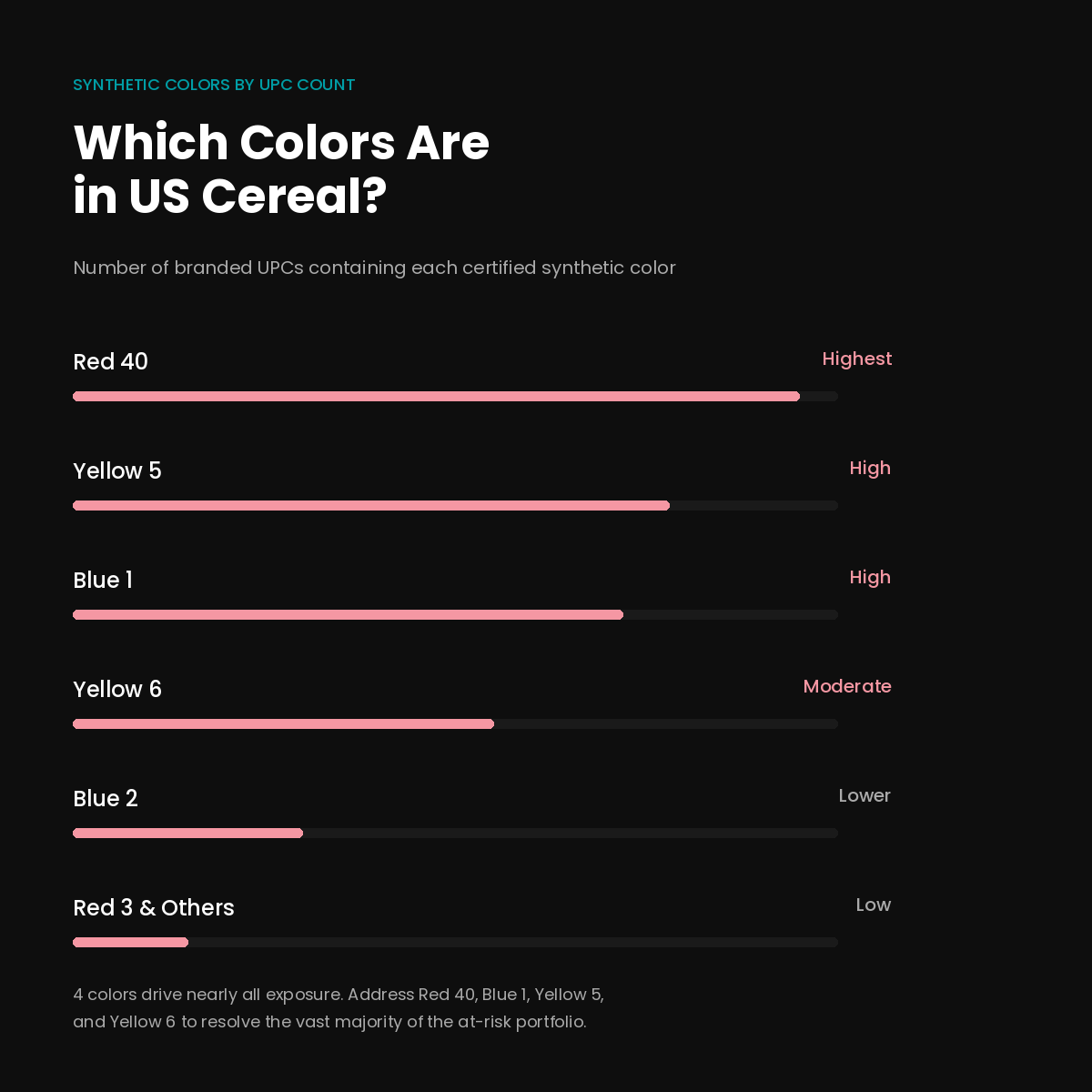
The concentration, though, is what makes this actionable. Four colors drive the vast majority of exposure: Red 40, Blue 1, Yellow 5, and Yellow 6. Address those four and you resolve most of the at-risk portfolio.
Who's Most Exposed
The exposure isn't evenly distributed. One major manufacturer has 71.6% of its cereal revenue tied to products containing synthetic colors, nearly all driven by a single brand. A second manufacturer sits at roughly 48% exposure across three of its brands. A third is at approximately 35%.
The outlier is the fourth major manufacturer, with just 12.6% of revenue at risk. Two of its key brands are already synthetic-free. That's a meaningful competitive advantage as retailers tighten clean-label requirements. Lower-exposure manufacturers can play offense, capturing shelf space from competitors forced into costly reformulations.
Among the top 12 brands by US dollar sales containing synthetic colors, three alone account for $689 million. Every one of those brands is sold at Target and at every other major retailer.
Target Is First. They Won't Be Last.
The domino effect is already in motion. Walmart has historically followed Target's clean-label moves across multiple categories. Kroger is expanding its Simple Truth private label line and aligning on regulatory trends across its banner. And at the federal level, the FDA's ban on Red 3 takes effect in January 2027, accelerating synthetic color scrutiny beyond retail mandates.
This isn't a single-retailer compliance exercise. The 383 exposed UPCs are sold across every major US banner. Companies that reformulate proactively don't just keep their Target shelf space. They gain first-mover advantage across their entire retail footprint.
What CPG Teams Should Do Now
In the first 90 days, the priority is visibility. Map every exposed product in your US portfolio across all retailers, not just Target. Plug those UPCs into store-level POS data to pinpoint which locations carry the highest concentration of at-risk products. Focus reformulation efforts on the highest-dollar brands first. And know where competitors are more or less exposed. Their gaps are your shelf space opportunity.
Beyond 90 days, the work shifts to building a portfolio that wins across the full retail landscape. That means building a reformulation roadmap that prepares your lineup for Walmart, Kroger, Costco, and beyond (not just Target). It means tracking how "no artificial colors" claims drive purchase intent and brand perception. And it means identifying natural color alternatives already winning in adjacent categories through product enrichment data.
Consumer sentiment around synthetic ingredients is accelerating. Brands tracking shopper insights at the attribute level, not just the category level, are the ones spotting clean-label whitespace before competitors do.
Teams that harmonize product data, consumer feedback, and market signals see what's shaping demand faster and with more confidence. Let's talk about how Harmonya turns fragmented data into decision-ready intelligence.
Schedule a personalized demo to see how Harmonya enriches product data, surfaces high-growth attributes, and maps shopper language back to the SKU level. We’ll walk through relevant category workflows, show how teams move from data cleanup to action, and answer questions about fit. Want proof first? Watch the Harmonya Enrichment Overview or explore Case Studies before booking.