Give your team a smarter way to work with product data-from attribution to insights. Harmonya connects product data to consumer reviews so you can act faster and compete smarter.
Super Bowl LX Is the First Real Test of Agentic Commerce
The Super Bowl is one of the most concentrated shopping occasions of the year. Millions of households prepare to host groups with different preferences, budgets, and constraints. This moment exposes a gap in modern commerce systems. Shoppers think in occasions and outcomes, while commerce systems still operate around products and keywords.
Agentic commerce promises to close that gap by translating natural language intent into complete shopping decisions. The Super Bowl offers a clear test of whether that promise holds. If an agent cannot turn “I am hosting a Super Bowl party” into a relevant, complete basket, the limitation is not the interface, it's the product data underneath.
This piece examines what happens when agentic shopping meets a real hosting scenario, why most brands & retailers could fall short, and how enriched, aligned product understanding changes the outcome for shoppers, retailers, and brands.
A Simple Request That Exposes a Complex Problem
Imagine a shopper opening a shopping agent a few days before the Super Bowl. It could be a built-in retailer assistant like Walmart's Sparky, an AI shopping helper, or a general-purpose AI connected to commerce platforms.
They type a simple request: “I’m hosting a Super Bowl party. About ten people. Some kids will be there. A couple of guests are vegan. I want snacks and drinks, and I don’t want to overthink it.”
This is not an edge case or a futuristic scenario. This is how people already talk to digital assistants today. The intent is clear, high-stakes, and time-bound. The shopper is not asking for specific products necessarily, but they're definitely asking for help planning an occasion.
What Happens Without Aligned Product Understanding
The agent attempts to respond. It interprets keywords like “Super Bowl,” “snacks,” and “drinks.” It pulls from categories and existing product metadata across the retailer’s catalog.
At first glance, the results seem reasonable: chips and dips appear, definitely need soda and beer, a few plant-based items are mixed in. Looks good at first...
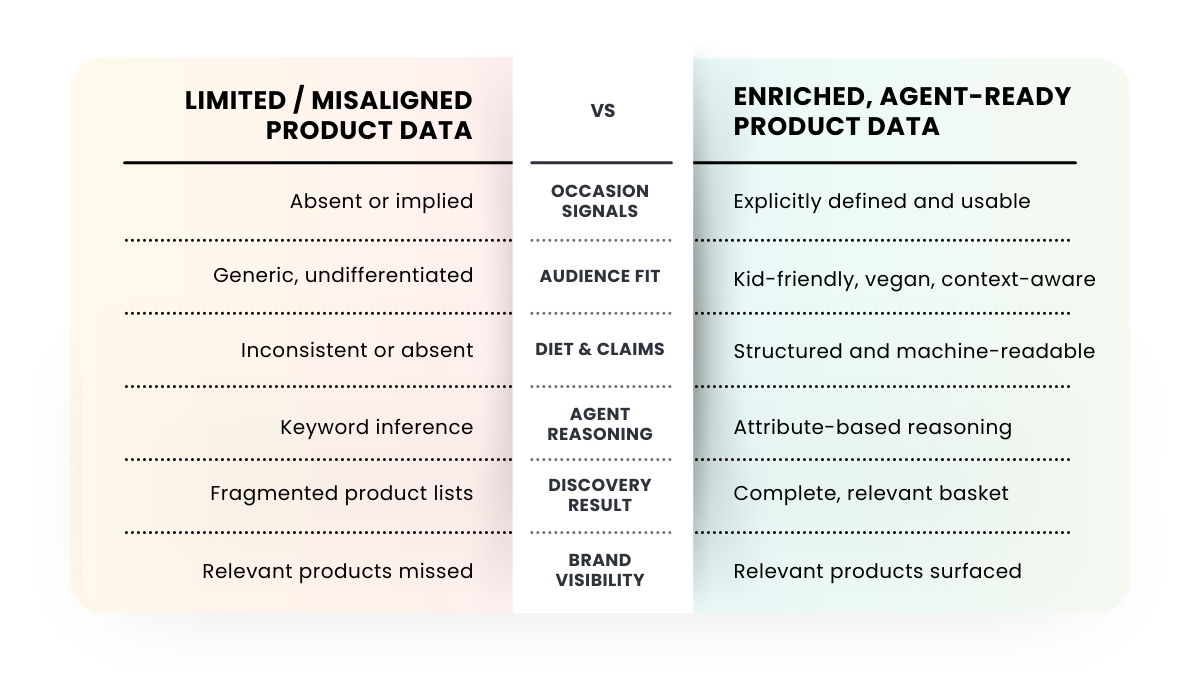
Then the cracks show. Vegan options are incomplete or scattered. Kid-friendly snacks include items with common allergens. Portion sizes don't account for a group. Products that would clearly fit the occasion exist in the catalog, but they are invisible to the agent because the system does not associate them with hosting, dietary needs, or audience suitability.
The shopper still has to think, filter, and scroll. And they don't feel like the agent is really helping them all that much.
From the shopper’s perspective, the assistant has not failed outright, but it has not delivered on the promise of reducing effort.
The Hidden Cost for Brands
This failure has consequences. In agentic commerce, products do not compete on shelf presence or brand recall, they compete on attributes.
If a product is not associated with specific occasions, audiences, or claims, the agent cannot reason about it. Visibility disappears, not because demand is absent, but because meaning is missing.
For brands, this creates a new risk. Products that are well positioned for real-world use cases lose relevance in agent-driven discovery. Marketing investment cannot compensate for incomplete product understanding. If the agent doesn't know who the product is for, it never enters the basket.
The Same Request, With Enriched Product Understanding
Now imagine the same interaction in a system where products are described using aligned, enriched attributes that reflect how shoppers think and speak.
The shopper repeats the request in Sparky or a similar assistant.
This time, the agent recognizes the occasion. It understands that “hosting a Super Bowl party” implies group quantities, variety, and ease. It interprets “kids” as an audience constraint. It treats “vegan” as a structured requirement, not a keyword.
The final basket looks different: snacks explicitly associated with party occasions surface naturally. Vegan options are integrated into the basket, not siloed. Kid-friendly products are filtered based on ingredients and format. Beverage selections account for both adults and children.
Notice nothing about the interface or agent has changed...what has changed is the agent’s understanding of the products it is choosing from.
The same shopper intent produces very different outcomes depending on how products are defined:
Why the Difference Comes Down to Product Language
The contrast between these two scenarios is driven by better product understanding, not better prompts or smarter agents.
Agents need attributes tied to usage, audience, dietary considerations, and context. They need consistency across listings and retailers, and they definitely need product meaning that mirrors how shoppers think.
Enriched product data provides this foundation. It translates real-world usage into structured signals and allows shopping agents to match intent to inventory without guesswork.
Implications for Brands and Retailers
For brands, agentic readiness becomes a visibility & discoverability question. Products must be understood in terms of who they serve, when they are used, and why they matter. Claims, audiences, and occasions are discovery inputs that will drive agentic commerce.
For retailers, trust shifts from interface to intelligence. Shoppers will judge agents on outcomes over experience, so the quality of product understanding determines whether agents earn repeat use or fade quickly.
For both, the work begins before the agent even responds. The Super Bowl shows that agentic commerce doesn't work without aligned, enriched product understanding.
Schedule a personalized demo to see how Harmonya enriches product data, surfaces high-growth attributes, and maps shopper language back to the SKU level. We’ll walk through relevant category workflows, show how teams move from data cleanup to action, and answer questions about fit. Want proof first? Watch the Harmonya Enrichment Overview or explore Case Studies before booking.